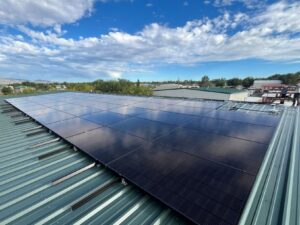
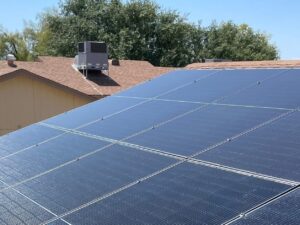
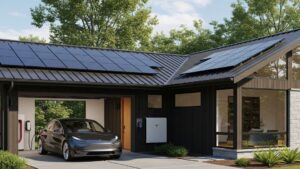
The 30% federal tax credit for homeowner-owned solar ended on December 31, 2025, and the national residential solar market has shrunk sharply since. Yet our install calendar at Rooftop Solar is fuller than it has been since last winter, and more than half of the solar systems we have installed in 2026 include a home battery.
So why are Arizona homeowners still going solar, and why are so many of them adding storage? The short answer: the reasons to produce your own power got stronger even as the incentive went away. Here is what the numbers say.
Key Takeaways
- Nationally, residential solar is forecast to shrink 23% in 2026 after the federal tax credit ended, but home battery installs are holding up far better, with only a 4% decline forecast.
- 46% of new U.S. home solar systems included a battery in Q2 2026, up from 41% a year earlier. At Rooftop Solar, 54% of our 2026 solar projects include a battery.
- APS and UNS Electric now credit exported solar at about 5.5 cents per kWh, while APS’s summer on-peak rate on its standard time-of-use plan is more than 34 cents. Storing your own power is worth far more than selling it.
- APS has requested an average 16% residential rate increase. The request is still pending before the Arizona Corporation Commission.
- With major national installers going bankrupt, the company that installs your system, and will still be here to service it, matters as much as the equipment.
The Tax Credit Ended. The Reasons to Go Solar Did Not.
Without a federal credit, more homeowners are deciding whether solar makes sense on its own merits, and for many Arizona households, the answer is still yes. The biggest reason is the price of power from the grid.
The U.S. Energy Information Administration expects the average U.S. residential electricity price to reach about 18.2 cents per kWh in 2026, nearly 5% higher than in 2025. Here at home, Arizona Public Service has asked the Arizona Corporation Commission for an average 16% increase for residential customers, about $20 a month. APS has also proposed a formula rate that would allow smaller rate increases every year without a full rate case.
Status as of October 16, 2026: both proposals are pending, not approved. A judge’s recommendation and a Commission vote are expected before the end of the year, and any approved increase would likely take effect in early 2027. We track the case in our APS rate increase update.
Every kilowatt-hour your panels produce is one you do not buy at whatever the future rate turns out to be. That logic does not depend on a tax credit.
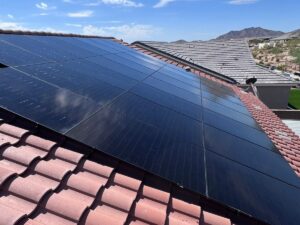
Exporting Pays Less, So Storing Pays More
Arizona’s regulated utilities no longer credit your extra solar power at the retail rate. Instead, they pay an export rate that has been cut repeatedly. In August, the Commission approved another 10% reduction for new APS and UNS Electric solar customers. Starting September 1, 2026, APS credits exported solar at $0.05554 per kWh, and the export rate has fallen about 57% since 2018. Each new customer’s rate is locked for 10 years from the time they interconnect.
Compare that with what you pay to buy power back in the evening. On APS’s Time-of-Use 4pm to 7pm Weekdays plan, the summer on-peak rate is about 34.4 cents per kWh. Sending your noon surplus to the grid for 5.5 cents and buying it back at 34 cents a few hours later is a poor trade. A battery lets you keep that energy and use it yourself during the expensive evening hours.
That math is why storage has gone from add-on to standard. According to the Q3 2026 U.S. Energy Storage Monitor from the American Clean Power Association and Wood Mackenzie, 46% of new U.S. home solar systems were paired with a battery in Q2 2026, up from 41% a year earlier. In the same quarter, residential storage installations rose 3% from a year earlier, while residential solar installations fell 12%. Arizona was one of the top five residential storage markets in the country, alongside California, Texas, Puerto Rico and Illinois.
Our own customers are ahead of the national curve. In 2026, 54% of the solar systems Rooftop Solar has installed include a battery. Learn more about how the technology works on our solar battery storage page.
Arizona’s Grid Peaks After the Sun Goes Down
Arizona’s electricity demand keeps setting records, and the peaks arrive in the evening. On July 24, both APS and SRP set all-time demand records as temperatures reached 117 degrees. APS broke its record again on August 2, when customers used 9,164 megawatts between 6 and 7 p.m., the fourth straight year of record peaks.
Notice the hour. Rooftop solar output is fading by 6 p.m., but air conditioners are still running hard. A battery charged by your own panels covers exactly that window.
Outages are part of the picture too. In April 2026, APS used a Public Safety Power Shutoff for the first time, cutting power to about 6,000 Flagstaff-area customers to reduce wildfire risk. In June, it did it again in and around Flagstaff and the Grand Canyon. Add monsoon storms in the summer and snowstorms up north in the winter, and backup power has become a practical concern for a lot of Arizona families. Our guide to preparing for power outages covers what a solar-plus-storage system can keep running.
Utilities are making the same bet homeowners are. Arizona became the third-largest battery storage market in the country in 2025, behind only California and Texas, mostly from grid-scale projects built to shift daytime solar into the evening.

Batteries Can Earn Their Keep
A home battery is not only a backup. Arizona utilities now pay battery owners to help the grid during those evening peaks:
- APS Storage Rewards: APS customers with an eligible battery earn a bill credit of $110 per average kW their battery contributes during summer events. APS can call up to 60 events per season, and battery-only systems can participate too.
- SRP Battery Partner: SRP’s pilot program pays incentives for battery participation, never discharges your battery below 20%, and is open to up to 5,000 customers through April 2030.
Payments depend on your battery, its settings and how many events are called, so we size every system around your goals first and treat program credits as a bonus, not a guarantee.
Already Have Solar? Add the Battery
A growing share of our work is adding storage to solar systems that are already on the roof. If your system was installed before the export rate cuts, a battery lets you keep more of your production at home and gives you backup power you did not have before.
Scott in Sedona already had a 12 kW array when he added two Enphase IQ Battery 10C units, so his daytime surplus now powers his evenings. Joel in Peoria went solar in 2025 and came back to add two Tesla Powerwall 3 batteries, which he says are awesome during an outage. Wondering if it makes sense for your home? Start with should I add battery storage to my existing solar system, or browse more stories on our Customer Spotlights page.
Why Your Installer Matters More Than Ever
The same pressures shrinking the solar market have pushed some of the biggest names out of business. Freedom Forever, once the second-largest residential solar installer in the U.S., filed for bankruptcy in April 2026 and moved to liquidation in August. It followed earlier failures including SunPower in 2024 and Sunnova in 2025.
Here is why that matters to you. Panel and battery manufacturers back their equipment, but the workmanship warranty that covers the installation itself, including the roof penetrations, wiring and mounting, comes from your installer. If the installer disappears, that coverage effectively disappears with it. A 25-year warranty is only as good as the company standing behind it.
Rooftop Solar has been designing, installing and servicing systems across Arizona since 2008 with our own licensed construction and electrical crews, in-house engineers and project managers. We plan to be here for the life of every system we install, and our Service Department also helps homeowners whose original installer is no longer in business, with repairs, inspections and removal and reinstallation.
Whoever you talk to, ask these questions before you sign:

- How long have you been installing in Arizona, and who will service my system in 10 years?
- Are your installers your own employees or subcontractors?
- What licenses do you hold? (You can look up any contractor with the Arizona Registrar of Contractors.)
- Who provides the workmanship warranty, and what does it cover?
- Are you certified by the manufacturers whose equipment you are proposing?
Our answers: Arizona ROC #283620 (R-11 electrical) and ROC #276363 (KB-1 general contractor); Tesla Certified Installer; Enphase certified; NABCEP certified; OSHA 10/30 certified (all installers); and NFPA 70E certified.
Thinking About Solar, Batteries or Both?
Whether you are starting from scratch or adding storage to panels you already have, we will look at your actual usage, your utility rate plan and your goals, then design a system around your home. Along with Tesla Powerwall and Enphase, we now install FranklinWH home batteries.
Request a free quote or call us at (800) 786-7080.
Frequently Asked Questions
Is solar still worth it in Arizona without the federal tax credit?
For many homeowners, yes. Rising utility rates, a pending APS rate increase and high evening time-of-use rates mean the power you produce and use yourself is worth more than it used to be. The value depends on your usage, roof, utility and rate plan, so the best way to know is a design based on your actual bills.
Is there still a federal tax credit for home batteries?
No. The federal Residential Clean Energy Credit (Section 25D) ended for homeowner-owned solar and battery systems installed after December 31, 2025. Utility programs such as APS Storage Rewards and SRP Battery Partner can still pay battery owners for helping the grid.
Can I add a battery to my existing solar system?
Usually, yes. Many of our recent projects add storage to existing solar, including systems we did not originally install. We review your current equipment, electrical panel and goals to recommend the right battery.
What is the APS solar export rate now?
For new APS customers who apply to interconnect between September 1, 2026 and August 31, 2027, the export rate is $0.05554 per kWh, locked for 10 years from interconnection. The rate for later customers can be reduced by up to 10% each year.
Sources
- U.S. Energy Information Administration, Short-Term Energy Outlook, Electricity: https://www.eia.gov/outlooks/steo/report/elec_coal_renew.php
- SEIA and Wood Mackenzie, Solar Market Insight Report Q3 2026: https://seia.org/research-resources/solar-market-insight-report-q3-2026/
- Solar Power World, ACP and Wood Mackenzie U.S. Energy Storage Monitor Q3 2026 coverage: https://www.solarpowerworldonline.com/2026/09/no-future-quarterly-declines-predicted-for-us-energy-storage-installation-market/
- American Clean Power Association, U.S. Energy Storage Monitor: https://cleanpower.org/resources/u-s-energy-storage-monitor/
- SEIA, Clean Energy Provisions in the One Big Beautiful Bill: https://seia.org/research-resources/clean-energy-provisions-big-beautiful-bill/
- KJZZ, APS rate increase request and formula rate proposal (March 5, 2026): https://www.kjzz.org/politics/2026-03-05/aps-wants-to-raise-rates-but-its-also-asking-for-a-major-overhaul-in-how-it-charges-customers
- Arizona Capitol Times, APS rate case hearing and timeline (May 19, 2026): https://azcapitoltimes.com/news/2026/05/19/aps-rate-case-kicks-off-with-hours-of-protest-over-14-rate-increase/
- Arizona Corporation Commission, APS rate case, Docket E-01345A-25-0105: https://www.azcc.gov/
- Pinnacle West Capital Corp., Form 10-Q for the quarter ended June 30, 2026 (APS RCP filing): https://www.sec.gov/Archives/edgar/data/0000764622/000076462226000041/pnw-20260630.htm
- PV Tech, ACC cuts Arizona solar export rate to 5.5 cents per kWh (August 2026): https://www.pv-tech.org/acc-cuts-arizona-solar-export-rate/
- APS, Time-of-Use 4pm to 7pm Weekdays plan: https://www.aps.com/en/Residential/Service-Plans/Compare-Service-Plans/Time-of-Use-4pm-7pm-Weekdays
- APS Newsroom, APS Customers Set New Peak Energy Demand Record (August 2026): https://www.aps.com/en/About/Our-Company/Newsroom/Articles/APS-Customers-Set-New-Peak-Energy-Demand-Record
- KTAR, Arizona utilities shatter energy demand records (July 2026): https://ktar.com/arizona-weather-news/aps-electricity-extreme-heat-record/5892674/
- AZFamily, How APS and SRP prepare for record demand (July 30, 2026): https://www.azfamily.com/2026/07/30/how-aps-srp-prepare-record-demand/
- APS Newsroom, Public Safety Power Shutoff in Effect in Flagstaff Area (April 22, 2026): https://www.aps.com/en/About/Our-Company/Newsroom/Articles/APS_Public_Safety_Power_Shutoff_in_Effect_in_Flagstaff_Area_to_Reduce_Wildfire_Risk
- APS Newsroom, APS Ends Public Safety Power Shutoff in Flagstaff and Grand Canyon Area (June 2026): https://www.aps.com/en/About/Our-Company/Newsroom/Articles/APS_Ends_Public_Safety_Power_Shutoff_Restores-Power_to_Flagstaff_Grand_Canyon_Area
- KJZZ, Arizona has the 3rd largest battery energy storage capacity in the U.S. (February 25, 2026): https://www.kjzz.org/business/2026-02-25/arizona-has-the-3rd-largest-battery-energy-storage-capacity-in-u-s-report-says
- APS Storage Rewards Pilot (APS program enrollment site): https://greatergrid.com/enroll/programs/batteries/apsstoragerewards
- SRP, Battery Partner program: https://www.srpnet.com/energy-savings-rebates/home/residential-solar/battery-partner
- pv magazine USA, Freedom Forever bankruptcy converted to Chapter 7 liquidation (September 9, 2026): https://pv-magazine-usa.com/2026/09/09/Freedom-Forever-Bankruptcy-Converted-To-Chapter-7-Liquidation-Key-Dates-Set/
- Rooftop Solar internal project data, 2026 battery attachment rate (54%)
Rates, programs and regulatory status are accurate as of October 16, 2026 and may change. Savings and program payments vary by home, usage, equipment and utility.